












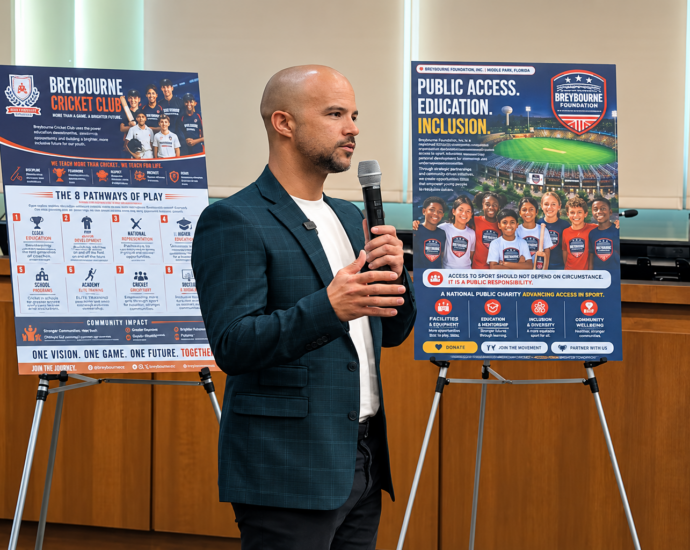
Groundbreaking is set to begin in the coming months on a massive professional cricket venue in Oswego, Illinois, marking the latest infrastructure bet on the sport’s commercial expansion in the U.S.
The proposed Breybourne Stadium, situated on a 33.5-acre site at Orchard Road and Tuscany Trail, is slated to eventually seat up to 25,000 spectators. Local officials and developers are positioning the seasonal facility designed to operate annually from April through October as a regional economic engine aimed at capturing the sport’s massive global audience.
“There is a lot of excitement,” Oswego Village Administrator Dan Di Santo said at a project kickoff event. “You can certainly feel it in the community and beyond when people hear Oswego, they associate Oswego with cricket.”
Oswego officials anticipate the multi-phase project will spur broader commercial activity, hotel demand, and tourism across the municipality, leveraging cricket’s position as the world’s second-most popular sport.
The venue is being developed in five phases to manage capital expenditure and traffic impacts. The initial phase covers field construction, pitch installation, and underground drainage infrastructure. Subsequent phases will incrementally scale capacity from 2,000 to 6,000, 14,000, and ultimately 25,000 seats, enabling the venue to host national and international fixtures.
Former South African international cricketer JP Duminy, who has been appointed Chief Cricket Officer for the project, highlighted the development’s grassroots-to-professional strategy.
“What attracted me to Breybourne is its commitment to building cricket the right way – from schools and academies through community cricket, clubs, leagues, and ultimately the professional game,” Duminy said. “I’m excited to help shape that future and contribute to growing cricket across the United States.”
To address local resident concerns regarding traffic and noise, developer Paresh Patel, chairman and CEO of Breybourne Stadium, agreed to construct a 6-foot privacy fence and route all event traffic directly onto Orchard Road, a regional transportation corridor designed for heavy volume.
Beyond municipal tax revenues, the development is expected to generate 100 to 200 construction jobs, alongside 50 to 100 permanent operational positions upon completion.
