












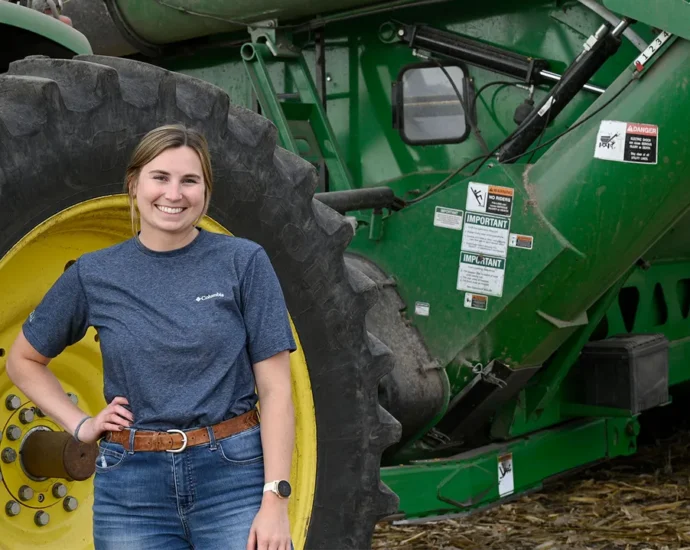
CROP INSURANCE UPDATES: Vanessa Wright, crop insurance officer at Compeer Financial, explains that there are many changes to crop insurance in 2026 that could impact a farmer’s selection, including increased subsidies for the Enhanced Coverage Option and Supplemental Coverage Option, and changes to the Beginning Farmer and Rancher Program. Ava Splear
At a Glance
- Starting in 2026, farmers can take the Supplemental Coverage Option while also taking Agriculture Risk Coverage.
- Farmers can add base acres in 2026 after the One Big Beautiful Bill Act allocated 30 million extra acres across the U.S.
- Experts warn that highly subsidized subsidies favor high-risk areas and may harm the integrity of crop insurance long term.
The government’s decision to increase crop insurance subsidy levels seems like a win for farmers. But is it harming crop insurance long term? While higher subsidies may provide short-term economic relief, experts are raising concerns about potential risks to the integrity of the crop insurance program.
For farmers, navigating changes to crop insurance and other policies is no small task. With the March 15 crop insurance deadline approaching, farmers must stay informed about these updates for effective decision-making.
According to Vanessa Wright, a crop insurance officer at Compeer Financial, farmers must start by knowing their cost of production. Wright serves several counties in northern Illinois and also helps on her family’s corn and soybean operation in Maple Park.
“I know we’re in a tight, tight margin climate right now. I know it’s hard to write that crop insurance check sometimes,” Wright said. “But really, if you can make sure you’re covering cost of production and breaking even, that can get you another year to where we see a little bit more relief in the markets.”
Related:Farm bill stalls over SNAP — Illinois counties tell bigger story
Here are five crop insurance changes to know for 2026:
1. Subsidies increase for certain options. Wright explained that the government has increased the subsidies for the Supplemental Coverage Option, Enhanced Coverage Option and Margin Coverage Option to 80%, up from 65% in 2024 and 44% in 2023. This higher subsidy significantly reduces premiums on these options, making them more affordable.
Gary Schnitkey, an ag economist at the University of Illinois, highlighted the financial impact of the increased subsidies. For example, if a farmer spent $15 per acre on SCO coverage in 2025, he or she would only pay $8.57 for the same coverage in 2026 due to the higher subsidy.
Those high coverage levels make a conversation with your crop insurance agent worthwhile, Wright said. These options provide county-level coverage in addition to the individual policies many farmers carry.
Jonathan Coppess, U of I ag policy professor, believes Congress likely increased the SCO subsidies to encourage more farmers to enroll in the program. However, he expressed concerns about the long-term implications of these changes.
Coppess explained that the increased subsidy levels for SCO favor high-risk areas, such as West Texas or other Southern regions. He is concerned that making insurance more favorable for high-risk areas poses a threat to crop insurance in the long run.
“Somebody’s paying for this in terms of paying a premium,” Coppess said. “It risks the integrity of the program.”
Related:Illinois farmer faces $250,000 pesticide application fine
Coppess noted that soybeans in Illinois rarely trigger indemnity payments. Farmers often purchase policies that do not result in payouts, which is what a farmer would expect.
“What’s really problematic is then on the other side of the equation, some of these crops in areas where you’re getting indemnities every year and they’re not paying for it in the premium cost,” Coppess said.
Schnitkey agreed with Coppess’ concerns, explaining that the higher subsidies in crop insurance get away from the original purpose of the program, saying it’s more like an income transfer program right now.
“It is an income transfer program, and it’s going to transfer more income to higher-risk crops and higher-risk areas,” Schnitkey said.
2. Farmers can take SCO while taking ARC. New in 2026, farmers can take the Supplemental Coverage Option and the Agriculture Risk Coverage program at the same time. Previously, farmers could only use SCO if they selected Price Loss Coverage for their acres.
Drawing on her experiences with clients, Wright explained that a lot of farmers choose ARC over PLC, and now they can take SCO with it.
The benefit of having both ARC and SCO is that farmers have a higher chance of receiving payments. Wright explained that ARC pays out more frequently than PLC. By taking SCO and ARC, farmers can gain additional county-level coverage while still benefiting from the more frequent payouts of ARC.
Related:Farmers speak out: When $12 billion in aid backfires
Schnitkey explained that separating ARC and SCO as independent choices is beneficial for farmers. “Now that it’s separated, they’ll make the best crop insurance choice without considering the commodity title and vice versa,” he said.
3. Farmers can add base acres. A change in the One Big Beautiful Bill Act allows farmers to update base acres in 2026, which is not permitted every year.
Coppess explained that the OBBBA allocated 30 million additional base acres across the country. However, not all farmers will be able to add base acres due to the limit. He said this won’t change a farmer’s underlying base acres, but farmers can add more if it fits within the 30 million.
“The reconciliation farm bill provided 30 million additional base acres to be apportioned across the country,” Coppess said. “And according to a USDA press release, the first acres that’ll be added are seed cotton. So, they’re allowing those first, and then they’ll figure out what’s left.”
Wright explained that the Farm Service Agency uses base acres, not planted acres, to calculate ARC and PLC payments. Updating base acres ensures that FSA administers payments based on the farmer’s current operation, if triggered.
Wright strongly advises farmers to update their base acres in 2026, especially if they are farming land that has not been included in their base-acre reports, such as newly acquired land, since their last acreage submission. That way, if ARC or PLC payments trigger, farmers will receive payment for these additional acres.
“If you’ve got a farm where those acres are not currently base acres, then you’d want to go into the FSA office and see if you can get those added to the farm,” Coppess said.
4. Beginning Farmer and Rancher Program expands. Wright explained that the Beginning Farmer and Rancher Program now offers 10 years of increased subsidies for crop insurance, up from five years previously.
Coppess described the increased subsidy for beginning farmers as one of the silver linings of the reconciliation farm bill. However, he stressed that while it’s positive, it does not offset the additional challenges that beginning farmers face, and that more could be done to help them.
On top of the standard government subsidy for all farmers, the government will provide young farmers with an additional crop insurance subsidy as follows:
- Years 1-2, 15%
- Year 3, 13%
- Year 4, 11%
- Years 5-10, 10%
For example, Wright said with a revenue protection plan with an 80% coverage level on enterprise units, the government would subsidize the policy at 71%, and a farmer would pay the remaining 29%. However, if a farmer is in his or her first year as a beginning farmer, the government would pay 86% and the young farmer would only pay 14%.
5. Farmers must reselect ARC or PLC for 2026. In 2025, farmers were granted the higher of ARC or PLC, regardless of what they selected. In 2026, farmers will need to reselect either ARC or PLC.
Wright explained that ARC payments happen more often, but if PLC payments are triggered, it pays more. “ARC is higher frequency, but in the event of a total disaster, you’re going to get more from PLC,” Wright said.
