










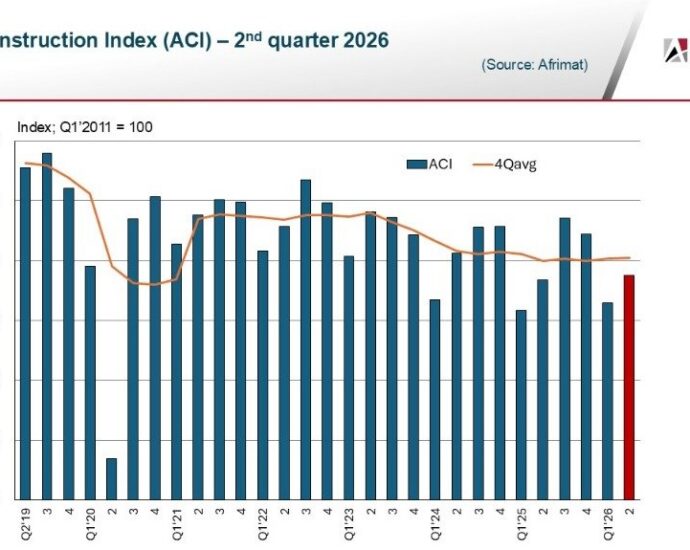
Botha, who compiles the Afrimat Construction Index (ACI), says the index increased by 0.7% year on year. Although this was slightly below GDP growth of 0.9%, he considers the employment gains encouraging.
“Against the background of a year-on-year decline in South Africa’s total employment during the second quarter, the sector’s creation of 95,000 jobs is exceptionally good news,” he says.
Four indicators in the latest index recorded consistent growth above July’s 4.3% inflation rate, both quarter on quarter and year on year: wholesale sales of construction materials; construction employment; the value of building plans passed by larger municipalities; and the volume of building materials produced.
“The quarter-on-quarter increase of 8.5% in the volume of building materials produced is especially encouraging,” Botha says. Real sales values for building materials also rose by 7% compared with the first quarter.
Although activity remains subdued, the ACI’s seasonally adjusted reading has stayed above its 2011 base level of 100 for four consecutive quarters. Botha says this signals a recovery from the effects of the State-capture era and the Covid-19 pandemic.
Five of the index’s ten indicators recorded positive year-on-year growth, while two others declined by less than 2%. Quarter on quarter, six indicators increased in real terms.
Botha says construction activity for the rest of this year and into next year could benefit from several potential growth drivers. These include the Metro Trading Services Reform Programme (MTSR), which has received a $1-billion loan from the New Development Bank. The government-led programme aims to improve metropolitan municipalities’ governance, financial sustainability and performance in water and sanitation, electricity and energy, and solid-waste management.
A potential decline in oil and fuel prices could also support the sector if geopolitical stability improves. Botha points to Venezuela’s stated intention to increase oil production by one million barrels a day. Lower fuel prices could ease inflationary pressure and create room for interest-rate cuts to resume, potentially by early next year.
There is also a larger pipeline of proposed projects. Industry Insights reports that South Africa’s 2026 Construction Book lists 110 projects worth about R396-billion, a 71% increase on the R232-billion recorded in the 2025 edition.
